What Is Cast Off
Garments, Labor, and Reclaimed Value in “This Water”
By Elinore Noyes • November 2025
Using objects that incorporate their own waste, Hadley Clark’s recent exhibition addresses an urgent question facing artists today: in a world built on human and environmental exploitation, how do we reclaim value? What is cast off in the act of making becomes both material and subject in This Water.
At times during her career as a fashion designer, Hadley Clark had been forced to piece together scraps of old garments when she couldn’t afford new yardage. Now, eight years after the closure of her store, that transfigurative process becomes the central creative exploration of This Water.
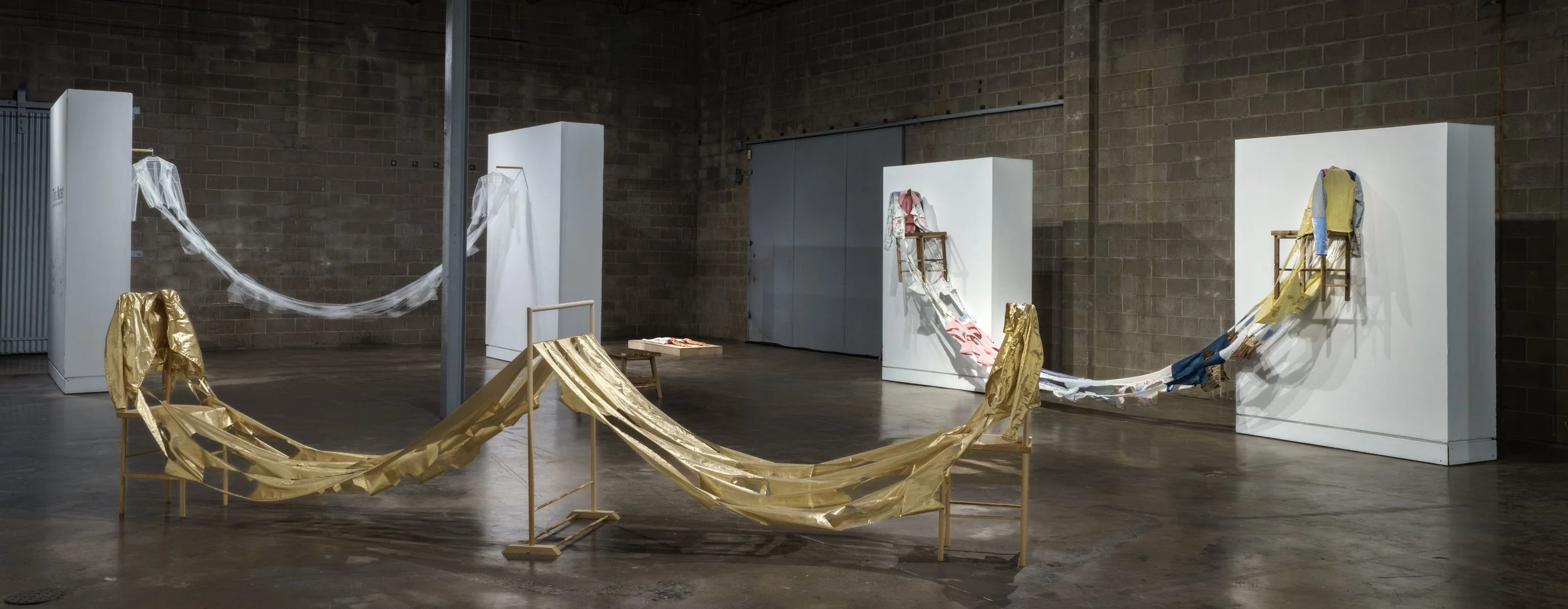
Installation view of "This Water." Courtesy Hadley Clark, photography by E.G. Schempf.The literal and conceptual interconnectedness of each work underscores Clark’s thesis: we are deeply enmeshed with the objects we create and consume. This idea started taking shape many years earlier, shortly after the closure of her store in 2017. The store was envisioned as a way to make a living doing what she loved.
But that was not what happened.
Fashion remains one of the most wasteful and exploitative industries in the world today, as a result, we expect garments to cost only a fraction of their “actual” worth. As rent soared and income stretched thin, Clark priced down her clothing just to make ends meet, asking far less for garments than their labor and materials demand, and still encountering indignation. Before long, this constant devaluation combined with creeping financial pressure had completely hollowed her work. The capitalist mechanisms meant to build a life as an artist had proved to be toxic.
Within months, she closed the store. She escaped to a small, private studio offered by a friend and later at Studios Inc as part of a two-year residency. The shift in Clark’s practice at that point was profound. From the quiet stillness that ensued, Clark began to make work again, reaching back toward an idea that had been fermenting for many years—garments that incorporated their own waste. Freed from commercial pressure, the process of reusing scraps became a mechanism to investigate the core conflict she experienced as an artist—the incompatibility between the human impulse to create and the capitalist mandate to extract.
Eight years later, This Water emerges as a fully realized answer.
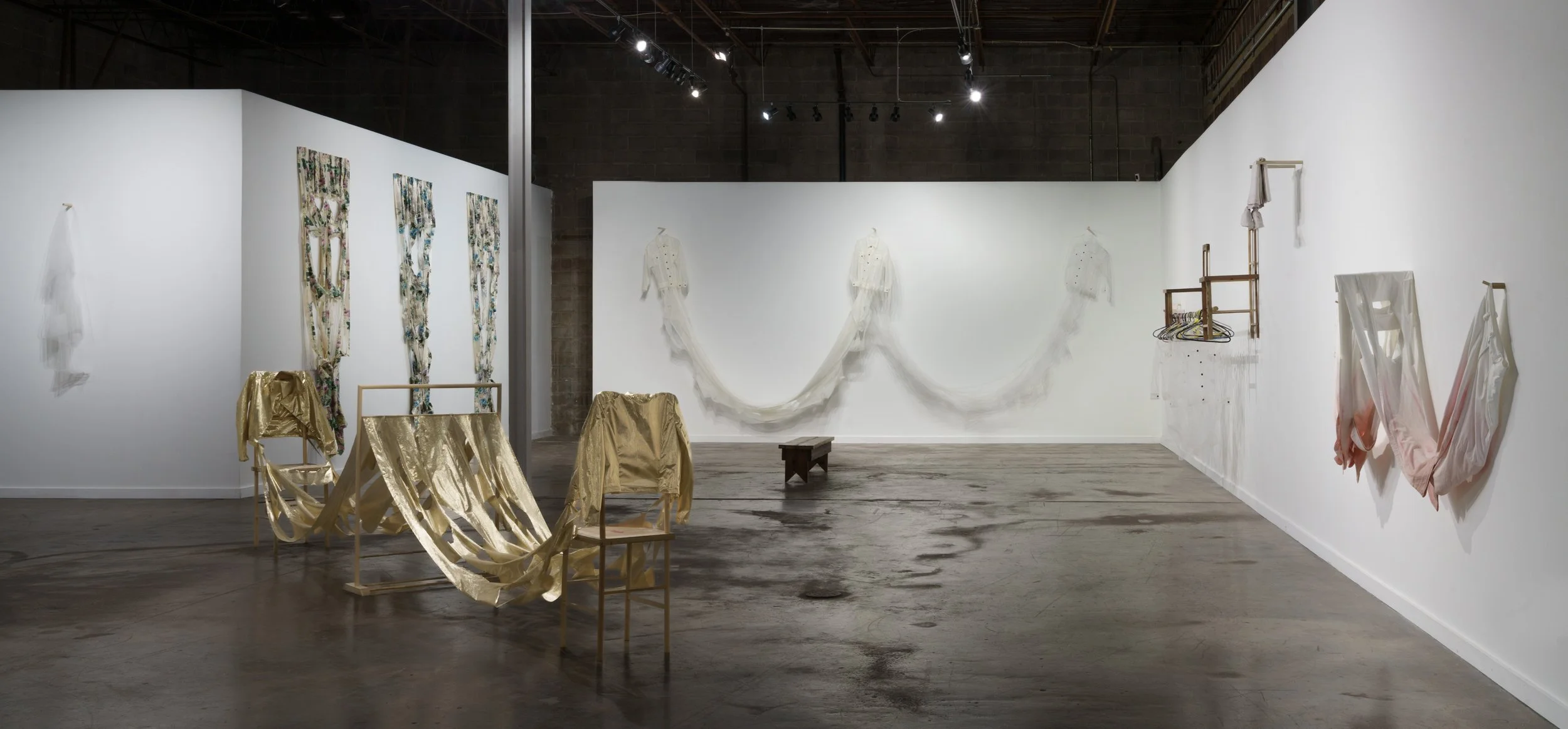
Installation view of "This Water." Courtesy Hadley Clark, photography by E.G. Schempf.Entering the industrial exhibition space at Studios Inc is stepping into a realm of ghosts. Sixteen sewn and sculpted pieces haunted the room: some suspended from chairs bolted to the wall, others pinned by magnets to wooden poles, a few neatly hung on glazed ceramic hangers. Together, they form a field of presence shaped by absence.
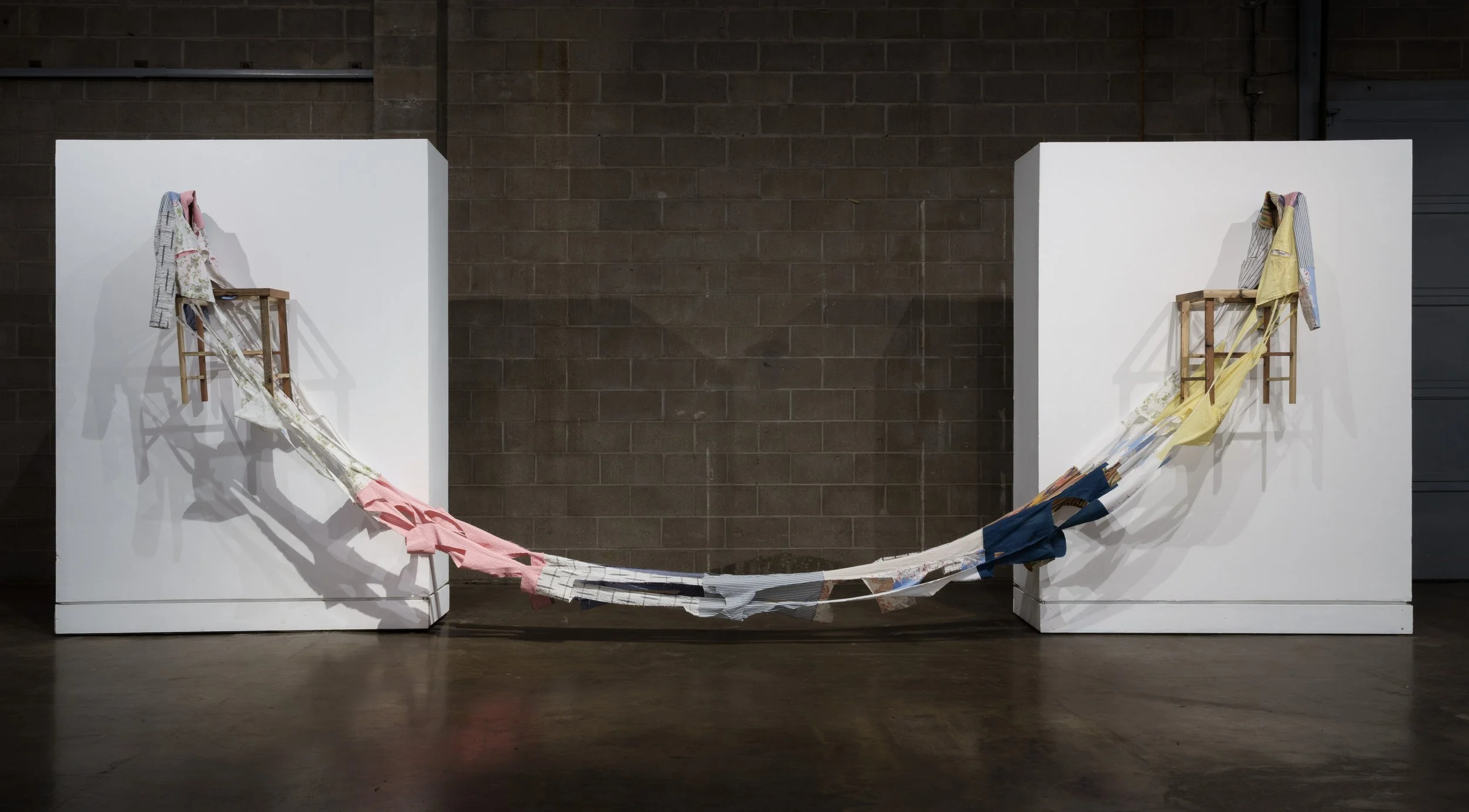
Mediums: Collage fills a wall with two jackets pieced together from discarded fabric. Draped over the backs of suspended wooden chairs, they face one another, joined by a choppy, undulating wave of patchwork scrap. Each section of material held its own opaque history: embroidered floral sheets, a red-checked picnic blanket, striped linen from a man’s suit. Reverberations of past times and places echo through the remnants of material, connecting their figurative silhouettes.
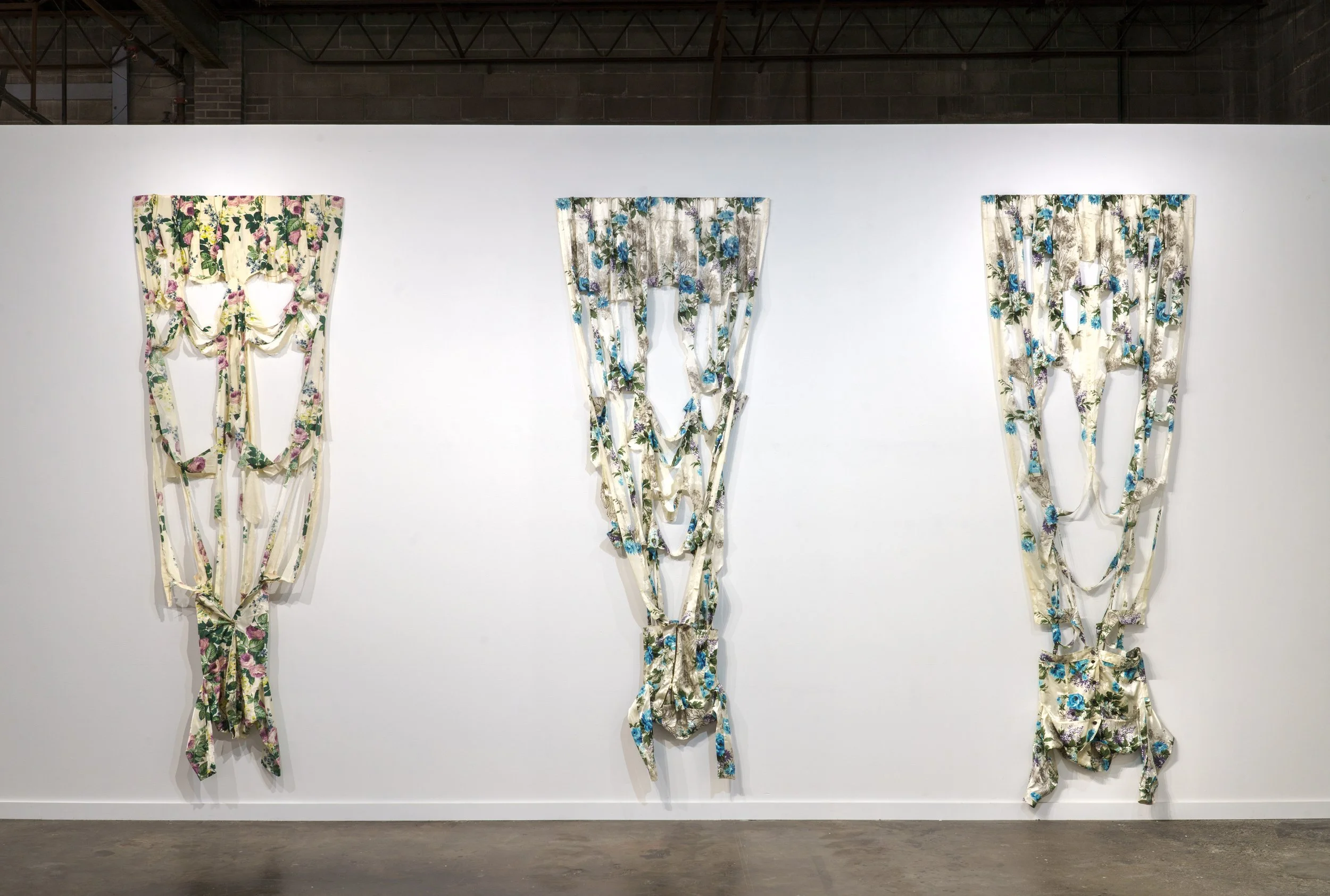
Installation view of "This Water." Courtesy Hadley Clark, photography by E.G. Schempf.Opposite them, a series of three monumental floral silk curtains occupies the far wall. At the base of each, a jacket made from the same fabric hangs upside down, arms limply outstretched, as though just born. Jagged holes consume the curtains’ mid-sections, as if the garments had gnawed away their contents—part newborn, part parasite.
Upon finishing the curtains, her partner, Kelly, described how Clark “ laughed and laughed…regarding them like something she had molted and was seeing as separate from herself for the first time.” Their transformation became a portrait—not only of Clark, but of the many others who had touched the curtains before her.
Installation view of "This Water." Courtesy Hadley Clark, photography by E.G. Schempf.Like water, the work in the exhibition confounds binary definitions of “product” and “waste,” reframing that artificial divide as a closed, continuous cycle.
The literal and conceptual interconnectedness of the works underscores Clark’s central proposition: we are deeply enmeshed with the objects we create and consume. The waves of ghostly fabric remnants remind us that our trash is the portrait that will tell our story thousands of years from now. This Water issues an urgent appeal to reject narrow, profit-driven definitions of value and to reclaim the natural resources already around us. In doing so, within that intentional disruption, the exhibition demonstrates how the things we make—slowly, together, and with care—have the power to reshape our lives and our legacies.
This Water was an exhibition by Hadley Clark on display from September 12 to October 25, 2025 at Studios Inc.