DOMESTIC APPRECIATION
On Living With Art Outside the White Cube
By Nyonu Branch-Watkins · January 2026
The interior of Blackbird Collection speaks in a hushed, confident register. The lighting consists of paper lanterns and arched chrome lamps, which float overhead like moons or afterthoughts, diffusing any sense of urgency across bleached wood, soft ivories, worn blacks, and muted sand tones. This is where we find Heidmann Art Salon’s curated exhibit, Black Out Black, in a space staged as a mood rather than a marketplace.
The exhibit brings together work by Laetitia Hohenberg alongside contributions from Gina Pisto, Lilly Marie Mueller, Phyllis Anne, Christy Powers, Phyllis Jenkins, and a photographic work by Ann Ray, a grouping that allows Hohenberg’s practice to operate less as featured content than as a structural spine.
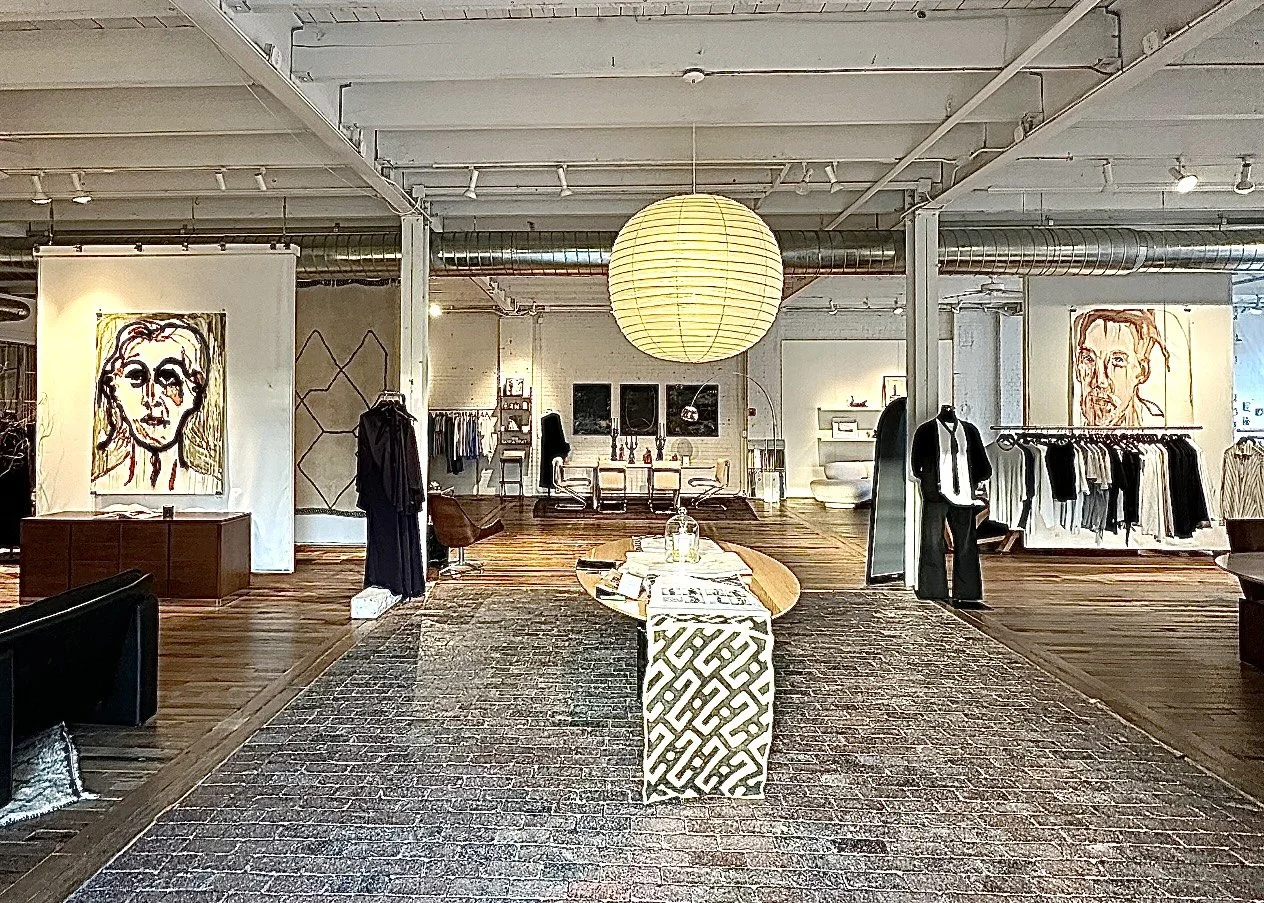
Installation view of “Black Out Black.” Courtesy of Heidmann Art Salon, photography by Scott Heidmann. Hohenberg’s paintings are scaled to the human body and insist on it in return: faces rendered with elongated restraint, eyes heavy-lidded or unfixed, bodies present but withheld. Flesh appears pale, bruised, or washed through with gray and umber, refusing both idealization and drama. Hohenberg describes her practice—spanning performance, dance, painting, sculpture, film, photography, poetry, and sound—as a long inquiry into the female condition. Here that inquiry unfolds through figures caught between interiority and exposure, self-possession and surveillance.
In a room already fluent in the domestic vernacular—lamps, textiles, softened corners—her paintings don’t need to shout to be legible. They speak the language of home deliberately, then subtly strain against it. Hung amid clothing racks, seating arrangements, and polished wood surfaces, the figures read less as portraits than as presences. Depicted are women who appear to inhabit the space rather than decorate it. In one painting, a nude female figure stands atop a layered, pedestal-like form, upright yet isolated, as if elevated by expectation rather than power.
This is why Hohenberg’s work feels like an anchor for the exhibition’s larger argument. In a space that imitates domesticity as a retail landscape, her practice insists that the domestic is not merely an aesthetic but a charged site. It is a structure where femininity is rehearsed, rewarded, disciplined, and sometimes refused. It is telling that Black Out Black situates her Paris-made work within its lineage: the “of-the-moment” interior meets an artistic practice already preoccupied with how women are asked to live inside inherited scripts. Against the familiar atmosphere, her figures register as quiet friction; bodies that do not dissolve into vibe, even as they are asked to reside within it.
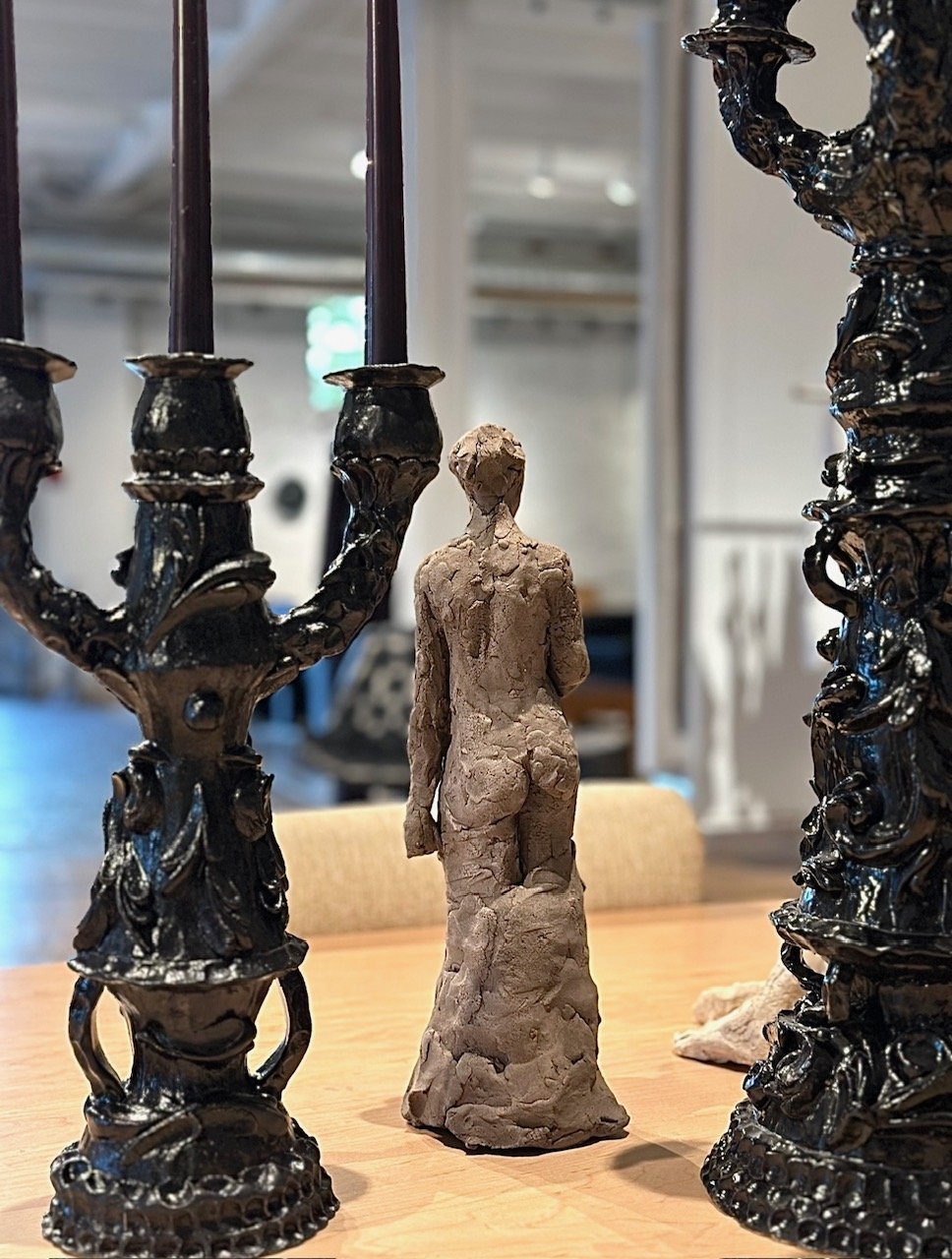
Installation view of “Black Out Black.” Courtesy of Heidmann Art Salon, photography by Scott Heidmann. Blackbird’s aesthetic, then, is unmistakably of-the-moment: post-minimal, post-industrial, post-everything. It draws from the now-familiar visual language of “quiet luxury,” Japandi restraint, wabi-sabi texture, and gallery-as-retail hybridity. Nothing here is loud, but nothing is accidental. This is a space fluent in Instagram, even when photographed empty—especially when photographed empty. In truth, the look is not original in the sense of being unprecedented. You have seen versions of this room before, in Brooklyn, Copenhagen, Los Angeles, online. The rugs, the chairs, the exposed beams, the softened brutalism: these are not surprises. They are citations.
If originality is often framed as human-ness, these rooms argue the opposite: that humanity lives in repetition, in recognition, in the comfort of seeing something familiar rendered lovingly again. Trends, then, are not shallow cycles but retellings of lived experience, responses to collective fatigue, desire, longing. Being “on trend” is not necessarily a failure of imagination, but a form of empathy, an attunement to the emotional weather of the moment.
I’ve thought often about Heidmann Art Salon's curation since visiting it, and about how a space can perform a quiet but radical kind of critical labor. Not by rescuing artworks from judgment, but by interrupting the speed and certainty with which that judgment usually arrives. In Blackbird Collection, a shop deftly imitating domesticity, art is allowed to be effectual without being exceptional. It can be personal without apology. It can exist without asking to be defended.
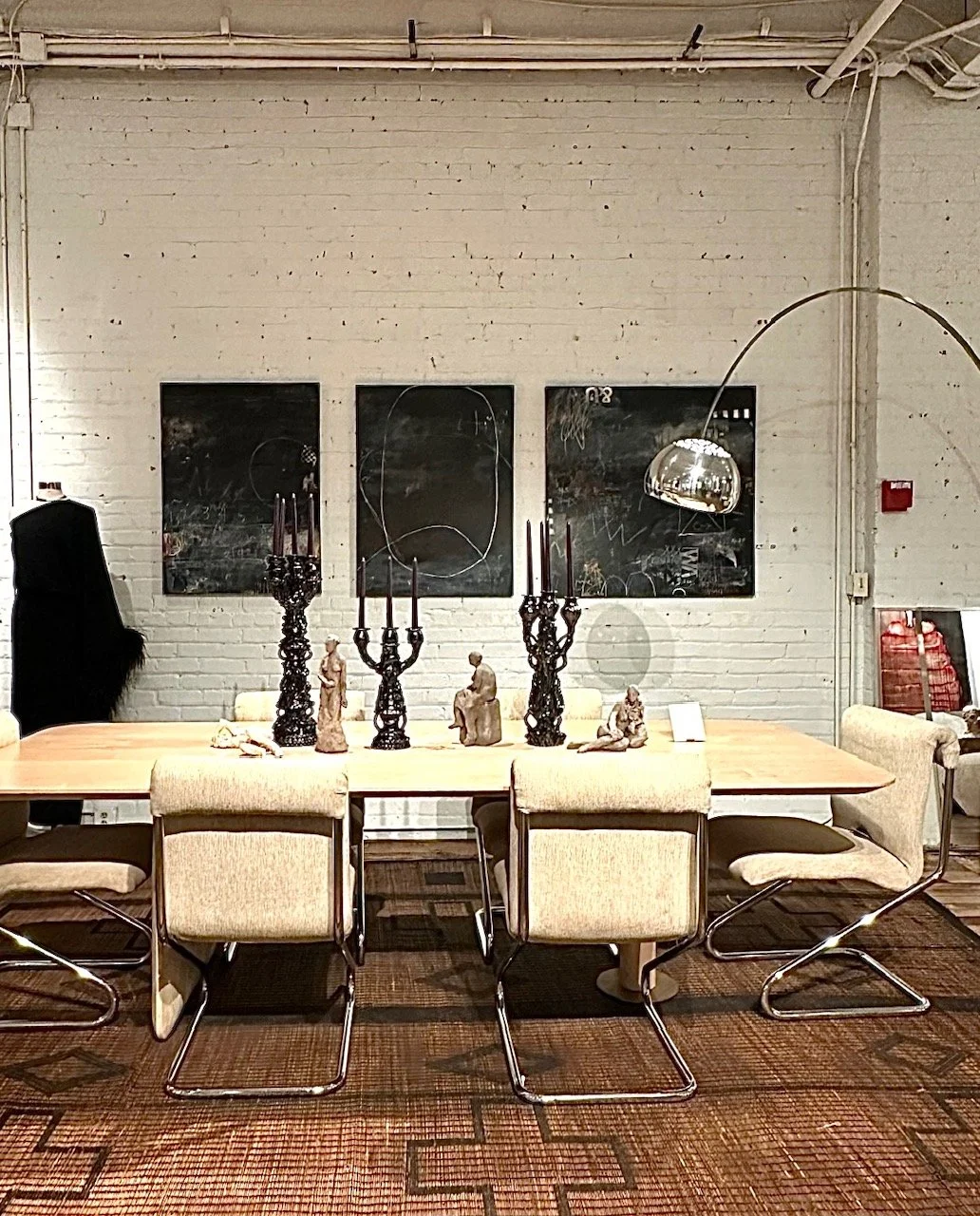
Installation view of “Black Out Black.” Courtesy of Heidmann Art Salon, photography by Scott Heidmann. The home has never been a neutral container for art. It is a charged site, dense with intimacy, labor, taste, and compromise. When art appears in domestic space, it risks contamination by association: too personal, too decorative, too lived-in. Museums, by contrast, promise purification. The white cube cleanses objects of context, demanding that they speak in the language of importance or not at all. In this way, institutional display performs a kind of aesthetic gatekeeping, one that privileges detachment over attachment, monument over memory.
This tension surfaces vividly in London Years, a black-and-white photograph by Parisian photographer Ann Ray. The image depicts a woman with long, stylized nails, a cigarette held loosely between her fingers. The background dissolves into blur while the hands remain crisp, careless, deliberate in their nonchalance. It is unmistakably the Cool Girl in Scene, an image that looks effortless because discipline has already done its work. We’ve seen her everywhere: magazines, films, art-school studios, Instagram feeds. She is less a subject than an archetype, a visual shorthand for a certain kind of aesthetic fluency.
Encountered cold, hung in a white cube, stripped of intimacy, the photograph would likely provoke an eye roll. It is one of more than thirty-five thousand images Ray made documenting the life and work of Lee Alexander McQueen through his tenure at Givenchy and into the establishment and success of his own label. Removed from that context, the photograph shifts from documentation to artifact. The subject matter matters less than the look. The cigarette reads as affect; the gesture as brand language. What circulates is not McQueen’s world so much as its residue, style abstracted into something portable, ownable, consumable.
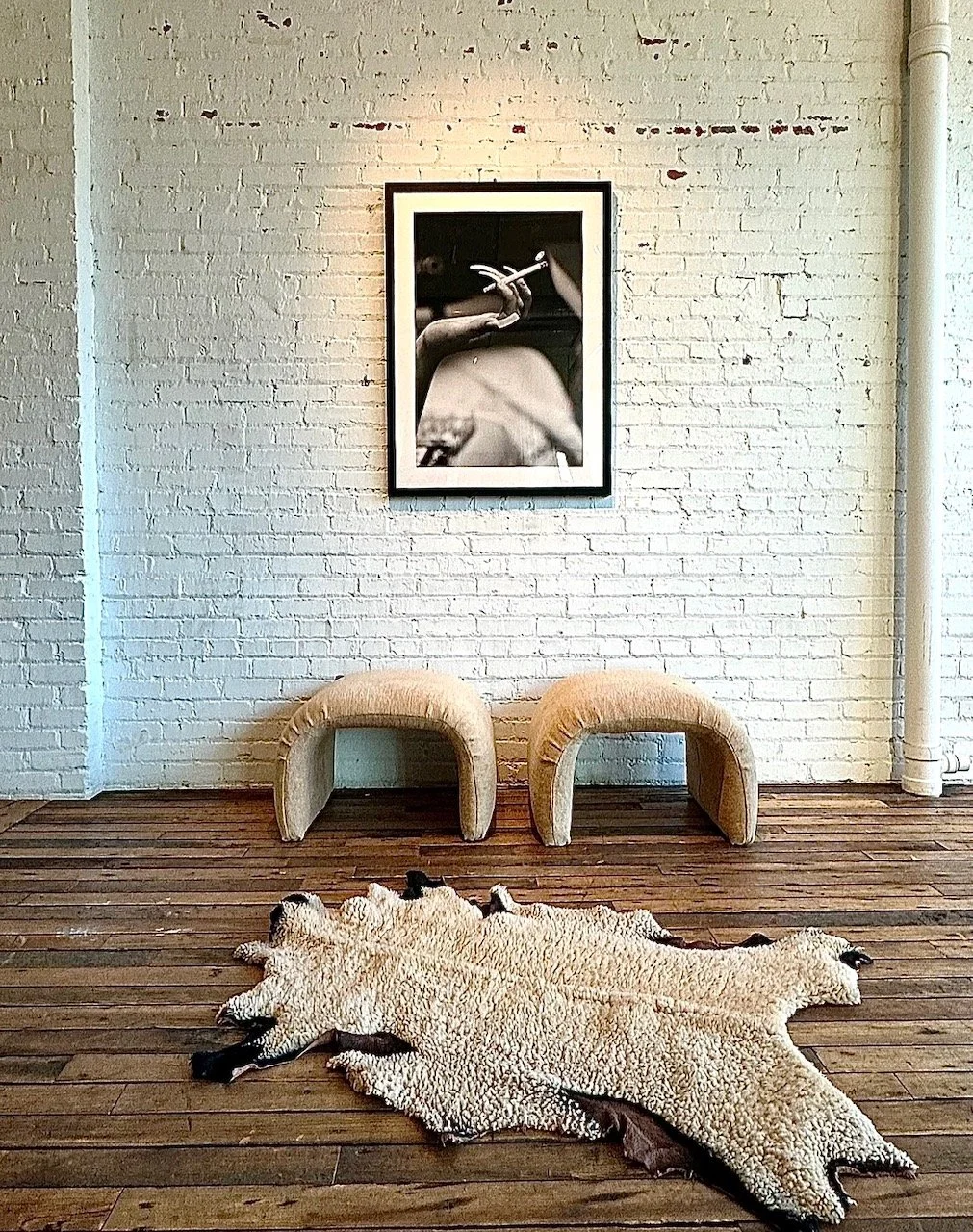
Installation view of “Black Out Black.” Courtesy of Heidmann Art Salon, photography by Scott Heidmann. This is where consumerism quietly enters the frame. Detached from its original function, the image becomes a transferable aesthetic, available without requiring knowledge of its origins. Meaning flattens into vibe. In a museum, this flattening feels cynical: the institution insists on significance while delivering recognition. The image promises depth but offers familiarity.
In the domestic setting of this exhibition, however, that familiarity becomes oddly forthright. Surrounded by furniture, textiles, and other objects acquired through taste rather than thesis, the photograph stops pretending to transcend consumption. It simply participates in it. Here, its value is no longer anchored to McQueen’s genius or Ray’s proximity to it, but to the quieter logic of living with images, how meaning accumulates through repetition, presence, and use.
I don’t like this photograph. It isn’t my style, even as I recognize the cultural fluency it signals. Yet imagining what it might mean to live with it, to pass it daily and allow it to recede and reassert itself over time, made space for a different kind of appreciation. Not museum appreciation, with its demand for justification, but domestic appreciation, a mode of attention that acknowledges consumerism not as a failure of meaning, but as one of the ordinary conditions through which meaning is made.
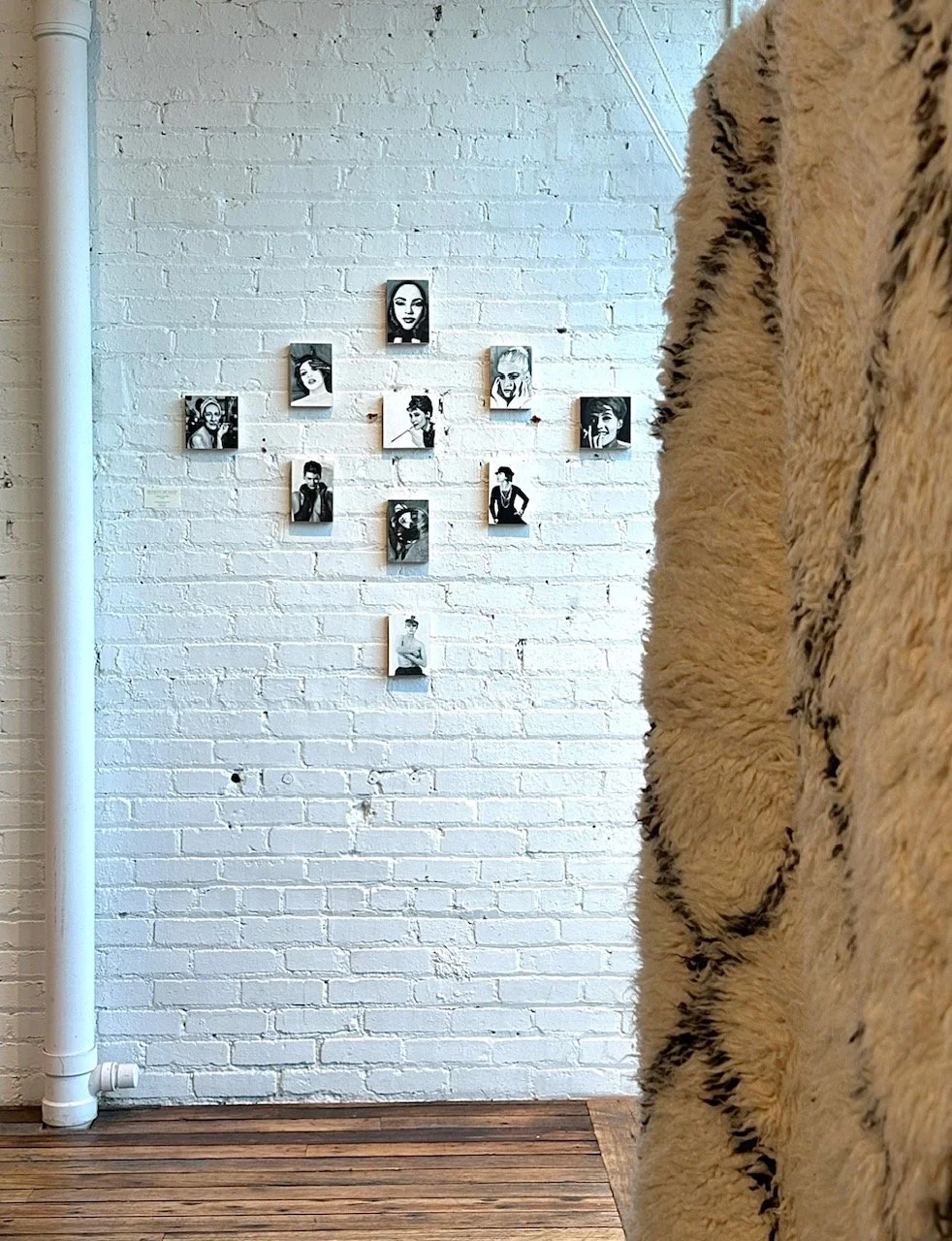
Installation view of “Black Out Black.” Courtesy of Heidmann Art Salon, photography by Scott Heidmann. Valuing aesthetic art, especially work that leans decorative, intimate, or excessive, is not a retreat from rigor. It is an expansion of it. Not all art needs to perform relevance at scale. Some works are not built for review cycles or canonical placement. They are built for companionship. To live with an artwork is to allow it to fade and resurface, to be occasionally ignored, and to matter differently over time. This kind of relationship resists the spectacle economy of contemporary art, which prizes constant legibility and immediate impact.
What emerges, then, is not a unique collapse between retail space, domestic interior, and art gallery, but a blur long produced by consumer culture, which borrows the language of home because intimacy sells. This is a contrivance, yes, but here is a quiet truth that it offers: the domestic is less a refuge than a training ground, one that shapes attention, behavior, and belonging through familiarity. Meaning is found not in leaving what we know behind, but in returning to it and recognizing what it has already made of us.
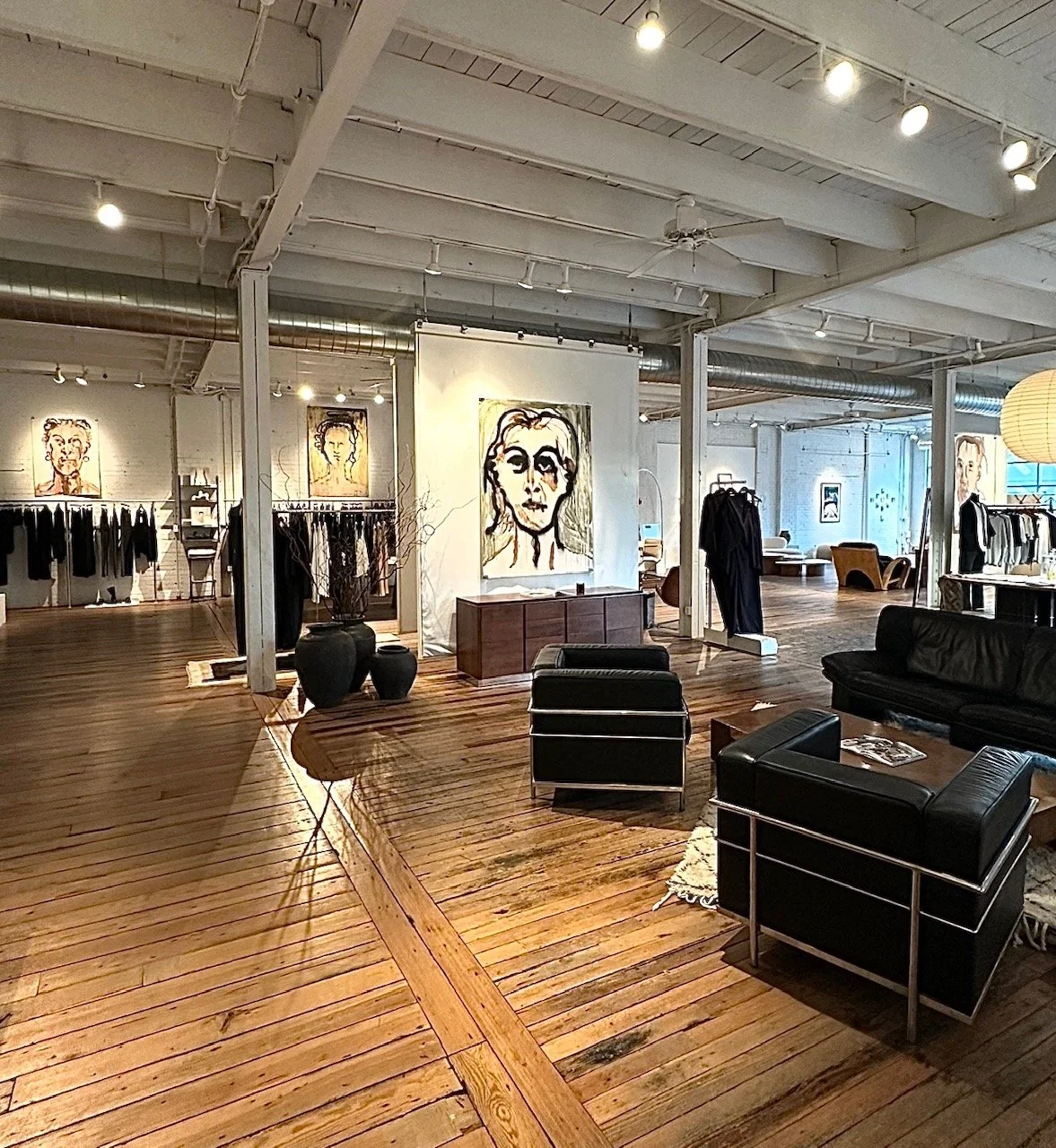
Installation view of “Black Out Black.” Courtesy of Heidmann Art Salon, photography by Scott Heidmann.